I came across a news article in the journal Nature discussing a new report by the IPCC. The study concludes that stabilizing CO2 concentrations at ~ 500 ppm would cost 0.12% global GDP per year over the next 30 years. By most accounts, this is good news. What caught my eye was the response from "James Connaughton, chair of the White House Council on Environmental Quality," who said, "But no world leader will pursue a strategy that would lead to economic recession." Really? What about the Iraq War, which costs the US about $250 billion per year (~ 1.89% of GDP), most of which is above and beyond the $500+ billion defense budget? By the administration's own acccount, the US has not entered a recession as a result of the war, although that money could be better spent. Of course there might be recessionary impacts of the War, but presumably the administration believes they are worth it to achieve desired foreign policy objectives. Therefore it cannot reject on principle that it opposes policies simply because they may be recessionary, but must argue that gains from policy would be less than their cost. Of course, this would be difficult to maintain in light of the growing realization that the costs of reducing carbon emissions fall well below the theoretical benefits.
Monday, May 07, 2007


Friday, April 27, 2007
Progress in China
Two news items caught my attention this week. The first, in the journal Science, discussed China’s new “green” railway into Tibet. The arid, cold plateau is sensitive to disruption and contains many rare and unique species. To limit their impacts, builders placed periodic tunnels to provide migration corridors; routed around important wetlands; designed stations to use recycled water that will not enter natural systems; and the list goes on. The second story, in the journal Nature, records China’s latest promise to begin reducing carbon emissions through less energy intensive growth, cleaner technology, and so on. Given their lack of transparency and poor track record of honesty, it is difficult discern China’s rhetoric from it's real intention, but the signs are promising. One reason to trust them now is that, as the Nature article points out, China (and other developing nations) will be the primary losers from climate change.
The more immediate benefit of China’s environmental progress is that it removes one of the few remaining (and most desperate) arguments against the US taking action on international environmental issues, particularly climate change. The tired mantra from climate change skeptics and defeatists is that unless China/India/Brazil reduce their emissions, the impact of the US will be meaningless. This was never a good argument, and it looks more sickly everyday. The US emits more absolutely and per capita than any other nation; it and Europe are almost entirely responsible for carbon emissions to date; and for the US to complain to developing nations about economic hardships of carbon reduction sounds like a bad joke when its GDP (PPP) per capita is $43500, compared to $7600, $3700, and $8600 in China, India, and Brazil, respectively. While I applaud China’s environmental progress, and hope it is genuine, there is still much the US and other developed nations can and should do, unilaterally if necessary.
The more immediate benefit of China’s environmental progress is that it removes one of the few remaining (and most desperate) arguments against the US taking action on international environmental issues, particularly climate change. The tired mantra from climate change skeptics and defeatists is that unless China/India/Brazil reduce their emissions, the impact of the US will be meaningless. This was never a good argument, and it looks more sickly everyday. The US emits more absolutely and per capita than any other nation; it and Europe are almost entirely responsible for carbon emissions to date; and for the US to complain to developing nations about economic hardships of carbon reduction sounds like a bad joke when its GDP (PPP) per capita is $43500, compared to $7600, $3700, and $8600 in China, India, and Brazil, respectively. While I applaud China’s environmental progress, and hope it is genuine, there is still much the US and other developed nations can and should do, unilaterally if necessary.
Sunday, April 22, 2007
Ecology, the social sciences, and enviromentalism
In my casual interaction with ecologists, I find no shortage of woefully uninformed yet forcefully stated opinions on the relationship between social sciences and the state of the environment. Fortunately, two recent essays recently published in the British Journal of Ecological Applications, provide refreshing, if sobering, perspectives. The first, written by the ecologist John Lawton, addresses why ecological science is (not) incorporated into policy decisions. In the second essay, economist Partha Dasgupta contrasts traditional accounts of economic growth (GDP and HDI) with indices of sustainable development that take into account the depreciation of natural capital. Neither essay paints a particularly rosy portrait for the future of the environment, but they succeed in highlighting why the belief that opining on social sciences doesn’t require specialized knowledge akin to natural sciences hampers progress. Since my comments on these essays turned out to be longer expected, I have posted the first part, on Lawton’s essay, below and will add another post on Dasgupta’s essay soon.
Lawton explains that ecology was not always an ‘activist’ discipline. Until moves in the 1960’s by the Ecological Society of America and the British Ecological Society, whom Lawton is addressing, these professional societies were not greatly involved in public affairs. Fortunately, in my opinion, this has changed. While I find ecology and allied sciences fascinating and intrinsically worthwhile, it would be a waste of knowledge and tax money, which funds most ecological research, if information were not disseminated to serve the public interest. Lawton highlights research that informed policy to curb acid rain in Europe as an example of success. In contrast, ecologists have not as yet been successful in using their findings to bring about policy change regarding other environmental problems, namely fisheries, GM crops, and climate change.
Lawton begins by dismissing two explanations for the failure of ecologically sound policy to take hold, namely corruption and the deficit model. While corruption is certainly rife in many developing countries, the evidence does not suggest that it is a major hindrance to environmental policy in developed countries like the UK. In the US, multiple political and business leaders recently or currently engaged in close, public judicial scrutiny seems to suggest that we do a decent job of rooting out blatant corruption. The deficit model, which states that politicians are simply too ignorant of science to make sound policy, is also wanting. While compelling, (as a biologist, I cringe nearly every time a politician, even an environmentalist, talks about nature), the deficit model provides little in the way of explanation because simply throwing more facts out does not make much difference. In reality, good science, however massaged and hand picked, often does eventually make it into political discussion, but even the best scientific evidence cannot immediately overcome competing interests and deeply held beliefs. Ecologists need to engage the economic, political, and cultural theories that account for resistance to reasonable environmental policy. At present, this is a rather humdrum assertion, but I have found that even those who acknowledge it usually do not move past a superficial engagement. Therefore, it is worthwhile to go over Lawton’s examples, adding my own thoughts along the way.
While there are still interesting questions to be answered, ecologists and fisheries scientists have essentially enough information to understand why so many fish populations are nearly depleted and how they could be rescued. First, how serious is overfishing? As a vegetarian, I am often asked if I eat fish. From a utilitarian perspective, I could argue that neurologically fish are advanced and sensitive to pain as any land animal eaten by humans. From an environmental standpoint, which is more important than animal suffering in my opinion, the case is no weaker. Studies that document overfishing are too numerous to list, though some are widely known, such as the collapse of cod fisheries in the northeast. For a more comprehensive view, quoting from Lawton, “the current biomass of large fish weighing 4–16 kg and 16–66 kg are 97.4% and 99.2% lower, respectively, than their pristine, prefishing state.” Furthermore, as discussed biologist Sean Carroll’s The Making of the Fittest, fisherman that preferentially catch larger and older fish, which is common, slow population recovery. Selection imposed by fisherman favors fish that reach maturity at a smaller size, which as a byproduct are less fecund than their larger ancestors.
Some argue that for certain fish, particularly salmon, we can reduce overharvesting through fish farming. Farming fish is just as harmful as farming livestock and poultry because it cannot circumvent two laws of biology: 1) animals need energy to grow, and that energy must be grown somewhere; 2) Fish, like cattle, produce waste which must go somewhere. Furthermore, fish farming creates unique problems. For example, salmon farms not only pollute nearby water systems, fish that escape farms threaten with natural populations through hybridization.
Through experiments, modeling, and observation, ecologists have shown that the adverse impact of overharvesting could be halted through innovative methods, such as establishing a series of no-take reserves. The idea is that in such reserves, fish can grow, multiply, and evolve more or less naturally. With sufficient and well-placed reserves, fishing can continue at high levels, while fish populations will not be overharvested or not evolve in undesirable directions. Resistance to no take reserves is multi-faceted. Clearly, special interest groups are threatened by regulations and anything that might reduce how much they can catch, even if the long-term sustainability of their industry is at stake. Fishing regulation is also opposed by conservative, which I use in the traditional sense of opposing change, elements of society. For example, fishing has played a role in shaping many cultures and economies. Others who enjoy the taste and purported health benefits may be reticent to give up or pay more for their cherished dining habits. More difficult still is the fact that fishing takes place largely outside the jurisdiction of individual countries, which can lead to suboptimal policy choices because no single country wants to move first without a guarantee that others will follow. Ecological knowledge is the not factor limiting sound fishing policy, but rather how we address and overcome the competing economic, social, and political resistance.
Lawton claims that ecologists have also more or less adequately addressed GM crops. The upshot is that genetic modifications may both harm and benefit, so crops must be evaluated on a case-by-case basis. The categorical resistance to GM in Europe, as opposed to the US where most soy and corn are GM, is, like resistance to fishing, motivated by conservative bias. It may come as counterintuitive, since GM is usually opposed by the left, while many biotech firms support the right. The reality is, however, that there is nothing liberal or progressive about opposing technology on the basis of a quasi-spiritual attachment to food prepared in a largely apocryphal pastoral agrarian setting in spite scientific (and historical) evidence to the contrary.
As opposed to fishing and GM crops, Lawton suggests that the climate change policy is scientifically less well informed. To be clear, he is not claiming that evidence for climate change is equivocal, but that ecologists are not certain how biological communities will respond and what that might mean for conservation. Interestingly, Lawton notes, policy is moving ahead of the science in this case, largely as an outcome of environmentalist’s success in overcoming opposition, also often ideologically conservative, to climate change. Specifically, plans are being drawn to prevent species extinctions due to climate change in Europe, but how this will be accomplished is awash in uncertainty. What is clear, from mesoscale experiments and theory, is that communities will not simply shift northward or evolve to meet the demands of the new climate. This is because communities are composed of diverse organisms, few of which respond identically, either within or between generations, to environmental change. The idiosyncrasy of species’ responses thus makes it difficult to predict with any accuracy the best conservation strategy. Much of what ecologists can recommend is rather general – a network of reserves that covers a diverse set of ecosystems, with corridors that may allow species’ ranges to adjust appropriately.
The lesson emerging from Lawton’s essay is that ecologists interested in effecting policy need not necessarily gather more data or simply educate politicians, but rather engage the social scientific understanding of resistance to evidence-based environmentalism. I have, more than Lawton, highlighted why conservative ideology (not always right-wing or republican) threatens policies related to fishing, GM crops, and (especially in the US) climate change. According to Lawton, tackling such entrenched belief systems and lifestyles is “messy, complex, and iterative.” However, the obvious sentiment provides little in the way of practical help. I personally advocate a greater emphasis on progressivism and rationality in education and public discourse, but these are hardly universally championed. The main point is that progress cannot occur so long as ecologists simply believe that anti-environmentalists are ignorant and need to be taught a lesson. Instead, we must understand the core social factors that motivate resistance and proceed from there. Let’s get going!
Lawton explains that ecology was not always an ‘activist’ discipline. Until moves in the 1960’s by the Ecological Society of America and the British Ecological Society, whom Lawton is addressing, these professional societies were not greatly involved in public affairs. Fortunately, in my opinion, this has changed. While I find ecology and allied sciences fascinating and intrinsically worthwhile, it would be a waste of knowledge and tax money, which funds most ecological research, if information were not disseminated to serve the public interest. Lawton highlights research that informed policy to curb acid rain in Europe as an example of success. In contrast, ecologists have not as yet been successful in using their findings to bring about policy change regarding other environmental problems, namely fisheries, GM crops, and climate change.
Lawton begins by dismissing two explanations for the failure of ecologically sound policy to take hold, namely corruption and the deficit model. While corruption is certainly rife in many developing countries, the evidence does not suggest that it is a major hindrance to environmental policy in developed countries like the UK. In the US, multiple political and business leaders recently or currently engaged in close, public judicial scrutiny seems to suggest that we do a decent job of rooting out blatant corruption. The deficit model, which states that politicians are simply too ignorant of science to make sound policy, is also wanting. While compelling, (as a biologist, I cringe nearly every time a politician, even an environmentalist, talks about nature), the deficit model provides little in the way of explanation because simply throwing more facts out does not make much difference. In reality, good science, however massaged and hand picked, often does eventually make it into political discussion, but even the best scientific evidence cannot immediately overcome competing interests and deeply held beliefs. Ecologists need to engage the economic, political, and cultural theories that account for resistance to reasonable environmental policy. At present, this is a rather humdrum assertion, but I have found that even those who acknowledge it usually do not move past a superficial engagement. Therefore, it is worthwhile to go over Lawton’s examples, adding my own thoughts along the way.
While there are still interesting questions to be answered, ecologists and fisheries scientists have essentially enough information to understand why so many fish populations are nearly depleted and how they could be rescued. First, how serious is overfishing? As a vegetarian, I am often asked if I eat fish. From a utilitarian perspective, I could argue that neurologically fish are advanced and sensitive to pain as any land animal eaten by humans. From an environmental standpoint, which is more important than animal suffering in my opinion, the case is no weaker. Studies that document overfishing are too numerous to list, though some are widely known, such as the collapse of cod fisheries in the northeast. For a more comprehensive view, quoting from Lawton, “the current biomass of large fish weighing 4–16 kg and 16–66 kg are 97.4% and 99.2% lower, respectively, than their pristine, prefishing state.” Furthermore, as discussed biologist Sean Carroll’s The Making of the Fittest, fisherman that preferentially catch larger and older fish, which is common, slow population recovery. Selection imposed by fisherman favors fish that reach maturity at a smaller size, which as a byproduct are less fecund than their larger ancestors.
Some argue that for certain fish, particularly salmon, we can reduce overharvesting through fish farming. Farming fish is just as harmful as farming livestock and poultry because it cannot circumvent two laws of biology: 1) animals need energy to grow, and that energy must be grown somewhere; 2) Fish, like cattle, produce waste which must go somewhere. Furthermore, fish farming creates unique problems. For example, salmon farms not only pollute nearby water systems, fish that escape farms threaten with natural populations through hybridization.
Through experiments, modeling, and observation, ecologists have shown that the adverse impact of overharvesting could be halted through innovative methods, such as establishing a series of no-take reserves. The idea is that in such reserves, fish can grow, multiply, and evolve more or less naturally. With sufficient and well-placed reserves, fishing can continue at high levels, while fish populations will not be overharvested or not evolve in undesirable directions. Resistance to no take reserves is multi-faceted. Clearly, special interest groups are threatened by regulations and anything that might reduce how much they can catch, even if the long-term sustainability of their industry is at stake. Fishing regulation is also opposed by conservative, which I use in the traditional sense of opposing change, elements of society. For example, fishing has played a role in shaping many cultures and economies. Others who enjoy the taste and purported health benefits may be reticent to give up or pay more for their cherished dining habits. More difficult still is the fact that fishing takes place largely outside the jurisdiction of individual countries, which can lead to suboptimal policy choices because no single country wants to move first without a guarantee that others will follow. Ecological knowledge is the not factor limiting sound fishing policy, but rather how we address and overcome the competing economic, social, and political resistance.
Lawton claims that ecologists have also more or less adequately addressed GM crops. The upshot is that genetic modifications may both harm and benefit, so crops must be evaluated on a case-by-case basis. The categorical resistance to GM in Europe, as opposed to the US where most soy and corn are GM, is, like resistance to fishing, motivated by conservative bias. It may come as counterintuitive, since GM is usually opposed by the left, while many biotech firms support the right. The reality is, however, that there is nothing liberal or progressive about opposing technology on the basis of a quasi-spiritual attachment to food prepared in a largely apocryphal pastoral agrarian setting in spite scientific (and historical) evidence to the contrary.
As opposed to fishing and GM crops, Lawton suggests that the climate change policy is scientifically less well informed. To be clear, he is not claiming that evidence for climate change is equivocal, but that ecologists are not certain how biological communities will respond and what that might mean for conservation. Interestingly, Lawton notes, policy is moving ahead of the science in this case, largely as an outcome of environmentalist’s success in overcoming opposition, also often ideologically conservative, to climate change. Specifically, plans are being drawn to prevent species extinctions due to climate change in Europe, but how this will be accomplished is awash in uncertainty. What is clear, from mesoscale experiments and theory, is that communities will not simply shift northward or evolve to meet the demands of the new climate. This is because communities are composed of diverse organisms, few of which respond identically, either within or between generations, to environmental change. The idiosyncrasy of species’ responses thus makes it difficult to predict with any accuracy the best conservation strategy. Much of what ecologists can recommend is rather general – a network of reserves that covers a diverse set of ecosystems, with corridors that may allow species’ ranges to adjust appropriately.
The lesson emerging from Lawton’s essay is that ecologists interested in effecting policy need not necessarily gather more data or simply educate politicians, but rather engage the social scientific understanding of resistance to evidence-based environmentalism. I have, more than Lawton, highlighted why conservative ideology (not always right-wing or republican) threatens policies related to fishing, GM crops, and (especially in the US) climate change. According to Lawton, tackling such entrenched belief systems and lifestyles is “messy, complex, and iterative.” However, the obvious sentiment provides little in the way of practical help. I personally advocate a greater emphasis on progressivism and rationality in education and public discourse, but these are hardly universally championed. The main point is that progress cannot occur so long as ecologists simply believe that anti-environmentalists are ignorant and need to be taught a lesson. Instead, we must understand the core social factors that motivate resistance and proceed from there. Let’s get going!
Friday, March 23, 2007
Brief comment on the value of nature
A commentator on Ecolog (an ecology list-serv to which I subscribe) had this to say:
"I say everything should have equal value and that value is priceless."
I emailed him a response, which I have copied below as it pertains to the subject of this blog:
Though you may say this, your behavior (as a normal human being, as clearly I do not know you personally) suggests otherwise. If all nature was of equal and infinite value, then by definition you would sacrifice anything to protect any part of it. In fact, I suspect that you spend some, even small, fraction of your resources to eat, travel, buy clothes, etc. However, you (like me) reach a point where, say, the next loaf of bread consumed is worth less than the preservation of a square foot of forest preserved, and you will sacrifice the loaf of bread to preserve forest. That is how you determine the relative price of forest preservation and bread. But rather than price everything in terms of bread and forest preserved, we use dollars for convenience. When economists valuate nature, they are not making an ethical statement, but describe how much, in aggregate, people are willing to sacrifice in order to preserve it. You deceive only yourself by saying that nature is of greater (infinite) value than your behavior demonstrates.
"I say everything should have equal value and that value is priceless."
I emailed him a response, which I have copied below as it pertains to the subject of this blog:
Though you may say this, your behavior (as a normal human being, as clearly I do not know you personally) suggests otherwise. If all nature was of equal and infinite value, then by definition you would sacrifice anything to protect any part of it. In fact, I suspect that you spend some, even small, fraction of your resources to eat, travel, buy clothes, etc. However, you (like me) reach a point where, say, the next loaf of bread consumed is worth less than the preservation of a square foot of forest preserved, and you will sacrifice the loaf of bread to preserve forest. That is how you determine the relative price of forest preservation and bread. But rather than price everything in terms of bread and forest preserved, we use dollars for convenience. When economists valuate nature, they are not making an ethical statement, but describe how much, in aggregate, people are willing to sacrifice in order to preserve it. You deceive only yourself by saying that nature is of greater (infinite) value than your behavior demonstrates.
Monday, March 19, 2007
Busy...
Between work and travel, I have been swamped lately, and thus my blog postings have clearly tapered off. I hope that things will settle down in the next couple weeks and I will be able to resume posting more regularly. Stay tuned!
Thursday, February 15, 2007
Skepticism and Climate Change
To the informed reader, it will come as no surprise that much debate surrounding climate change centers of scientific uncertainty of future events. The naïve reaction to uncertainty, originally developed by the skeptics of ancient Greece, holds that since reality is unknown and unknowable*, attempting to make scientifically informed decisions is futile. While little of their “dogmatic doubt”† lives on, the term skeptic survives today. Contemporary skeptics doubt until proven certain. Depending on how much evidence one requires for certainty, those of an overly skeptical disposition can resemble their intellectual forefathers in apprehension toward nascent scientific consensus. This is not say skeptics are apprehensive toward science generally. To the contrary, most either come from scientific backgrounds or are admiring onlookers. Given their prejudice for doubt, it is unsurprising, albeit disappointing, how critical and dismissive many skeptics have been over environmental issues, particularly climate change. Skeptics, like all serious commentators, acknowledge the scientific consensus that the earth is warming and that human activities are partially responsible. However, because the future consequences of climate change are uncertain and regularly exaggerated, they oppose or are critical of remedial policy. However, inaction due to skepticism is itself a tacit choice, as I show below, one more at odds with science than sensible climate change policies. Using skepticism to justify complacency reveals a willful ignorance or misinterpretation of evidence rather than genuine uncertainty.
Climate change skeptics contend that we do not have enough evidence to authorize significant policy changes. In taking a position of ignorance, they assume 1) that we do have enough evidence to justify not making significant changes and 2) that current policies are optimal, such that adopting policies targeted at mitigating climate change could only cause harm.
On the first count, climate scientists easily resolve the issue by putting error bars around informed predictions. Current scientific predictions do not rule out catastrophic climate change in the near future, but neither do they claim it inevitable. Similarly, beach house owners cannot predict with any certainty that a hurricane will or will not hit their home on any given year. As uncertainty does not prevent them buying insurance, nor should uncertainty regarding climate change prevent sensible policy choices. Certainly there is no evidence to suggest that complete inaction is justified.
Even if one is skeptical in spite of the evidence, is there good cause to categorically oppose policies that remediate climate change? Many policies could have positive effects besides reducing green house gas emissions. For example, investment in green technology research may reduce greenhouse gases while promoting overall efficiency. Furthermore, as Thomas Friedman in particular has argued, the US, China, and others do no favors to countries like Iran by continuing to import large quantities of oil. In Iran, oil revenues are used to fund a populist state that redistributes money to its burgeoning population, not to mention nuclear proliferation. Consequently, many grow fat on state support without producing anything of value or investing in non-petroleum sectors. In the long run, this may lead to economic and political instability, evidenced by the poor condition of most resource rich economies (Canada and Norway are notable exceptions).
While there will be external benefits to climate change policy, there is little evidence that the costs will be burdensome. Polluters historically exaggerate the cost of halting pollution, as evidenced by the case of sulfur dioxide emissions. In his book The Undercover Economist, Tim Harmon shows that prior to a pollution permit auction, companies and the EPA estimated that reducing sulfur dioxide emissions would cost $250-700 per ton. However, “when the EPA conducted the auction in 1993, very few polluters made high bids…By 1996, permit prices had fallen to $70/ton.” Because real money is at stake, auctions force companies to tell the truth. I suspect that we are seeing the same pattern again - companies and politicians in their pay embellish the cost of reducing greenhouse gas emissions. Currently, carbon credits in the EU and US sell for far less than $20/ton. Since the average world citizen emits approximately 4.4 tons/year, reducing carbon emissions to zero could conceivably cost less than $100 per person. I doubt it would actually be this cheap, because price would likely rise as emissions approached zero, but it does suggest that significant greenhouse gas reductions could be made at costs far lower than groups like the American Enterprise Institute would have you believe.
The upshot is that the best scientific, economic, and political evidence only occasionally informs policy choices. Belief to the contrary is itself unwarranted by the evidence, and therefore fear of any change is irrational. Skeptics and others, like the secretary of the Department of Energy, respond by invoking the law of unintended consequences to justify complacency. However, the consequences surrounding current policies (e.g. that oil imports could induce political instability and/or spur nuclear proliferation in countries like Iran) are likely as uncertain as those of many proposed policies. The conservative position that resists change tacitly favors current uncertainty over future uncertainty, a position that would need to be substantiated if it is to be believed.
From the contemporary skeptical attitude, useful in provoking scientific inquiry, it does not follow that no policy should be enacted to mitigate climate change. The complacent view fails to acknowledge the current evidence and places an unwarranted faith in the status quo. It stands to reason that such a perspective can only be maintained either out of ignorance or ideology.
* One does wonder how they knew this to be true.
† From Bertrand Russell’s The History of Western Philosophy
Climate change skeptics contend that we do not have enough evidence to authorize significant policy changes. In taking a position of ignorance, they assume 1) that we do have enough evidence to justify not making significant changes and 2) that current policies are optimal, such that adopting policies targeted at mitigating climate change could only cause harm.
On the first count, climate scientists easily resolve the issue by putting error bars around informed predictions. Current scientific predictions do not rule out catastrophic climate change in the near future, but neither do they claim it inevitable. Similarly, beach house owners cannot predict with any certainty that a hurricane will or will not hit their home on any given year. As uncertainty does not prevent them buying insurance, nor should uncertainty regarding climate change prevent sensible policy choices. Certainly there is no evidence to suggest that complete inaction is justified.
Even if one is skeptical in spite of the evidence, is there good cause to categorically oppose policies that remediate climate change? Many policies could have positive effects besides reducing green house gas emissions. For example, investment in green technology research may reduce greenhouse gases while promoting overall efficiency. Furthermore, as Thomas Friedman in particular has argued, the US, China, and others do no favors to countries like Iran by continuing to import large quantities of oil. In Iran, oil revenues are used to fund a populist state that redistributes money to its burgeoning population, not to mention nuclear proliferation. Consequently, many grow fat on state support without producing anything of value or investing in non-petroleum sectors. In the long run, this may lead to economic and political instability, evidenced by the poor condition of most resource rich economies (Canada and Norway are notable exceptions).
While there will be external benefits to climate change policy, there is little evidence that the costs will be burdensome. Polluters historically exaggerate the cost of halting pollution, as evidenced by the case of sulfur dioxide emissions. In his book The Undercover Economist, Tim Harmon shows that prior to a pollution permit auction, companies and the EPA estimated that reducing sulfur dioxide emissions would cost $250-700 per ton. However, “when the EPA conducted the auction in 1993, very few polluters made high bids…By 1996, permit prices had fallen to $70/ton.” Because real money is at stake, auctions force companies to tell the truth. I suspect that we are seeing the same pattern again - companies and politicians in their pay embellish the cost of reducing greenhouse gas emissions. Currently, carbon credits in the EU and US sell for far less than $20/ton. Since the average world citizen emits approximately 4.4 tons/year, reducing carbon emissions to zero could conceivably cost less than $100 per person. I doubt it would actually be this cheap, because price would likely rise as emissions approached zero, but it does suggest that significant greenhouse gas reductions could be made at costs far lower than groups like the American Enterprise Institute would have you believe.
The upshot is that the best scientific, economic, and political evidence only occasionally informs policy choices. Belief to the contrary is itself unwarranted by the evidence, and therefore fear of any change is irrational. Skeptics and others, like the secretary of the Department of Energy, respond by invoking the law of unintended consequences to justify complacency. However, the consequences surrounding current policies (e.g. that oil imports could induce political instability and/or spur nuclear proliferation in countries like Iran) are likely as uncertain as those of many proposed policies. The conservative position that resists change tacitly favors current uncertainty over future uncertainty, a position that would need to be substantiated if it is to be believed.
From the contemporary skeptical attitude, useful in provoking scientific inquiry, it does not follow that no policy should be enacted to mitigate climate change. The complacent view fails to acknowledge the current evidence and places an unwarranted faith in the status quo. It stands to reason that such a perspective can only be maintained either out of ignorance or ideology.
* One does wonder how they knew this to be true.
† From Bertrand Russell’s The History of Western Philosophy
Friday, January 26, 2007
‘Wildlife-friendly farming’ versus ‘Land sparing’
I recently came across a two year old paper by four biologists published in the journal Science. Brazenly titled “Farming and the Fate of Wild Nature,” the authors less than subtlety suggest that there is a lot at stake. There is! They report that 50% of natural habitat on arable land has been cleared for agriculture, and while forests are regrowing in the developed world, deforestation continues apace in the developing world, which houses most of the world’s biodiversity. Using data from an international database of threatened birds, they also demonstrate that agriculture adversely affects biodiversity. As both population and affluence continue to rise for the foreseeable future, agriculture will continue to pose a serious threat to wilderness.
Two general strategies have been proposed to mitigate the adverse affects of agriculture:
The authors’ primary purpose with this article is to provoke an empirical research program, not generate conclusions. Nonetheless, they tepidly support the land sparing strategy on the premise that many species, especially those of conservation concern, seem to exhibit a convex density-yield function. If correct, the results would advocate the position of the green revolution: high yield, high input agriculture is optimal both for people and the environment.
The authors anticipate three potential limitations of their approach, one of which I address here. Their model does not incorporate effects on wildlife populations on nonfarm land, a widely cited example being the dead zone in the Gulf of Mexico caused by chemical runoff from farms. Incorporating such externalities might shift the balance in favor wildlife-friendly farming. This is an important concern, but the street goes both ways. External effects of agriculture are a product of both intensity and area. Intensive farming has high external environmental costs per unit area, but they must be weighed against reduced external costs per area spread over a larger land area. For example, an abundance of low yield farms could increase habitat fragmentation.
I suspect there may be two more general criticisms that arise, not necessarily to this paper in particular, but to this approach to conservation, especially if it turns out that the convex function is more common, favoring a land sparing approach. First, a critic might claim that this is “just a model,” too abstract for the complexity of real ecosystems and overly reductionist, breaking ecosystems down into constituent species and functions. Such criticisms are wrongheaded. The real dichotomy is not abstraction/realism, reductionism/holism, but rather those who acknowledge their working models and those who do not. It is trite, but worth repeating, that our perception of the world is not an unadulterated version of sensory input. Rather, we all use models, conscious or otherwise, to make sense of reality. Mathematical models formalize this innate process and bring it the forefront of our consciousness, permitting critical evaluation. The alternative is blind surrender to our preconceptions.
Another complaint might be that the paper establishes false premises and ignores a possible third way. In particular, the small-scale, labor intensive, beyond organic, local farming movement. Relying on greater local knowledge and increased inputs of manual labor, such farms have high, sustainable yields without large inputs of chemicals or machinery. At least, that is the anecdote, as I have not seen a systematic study that bears this out. Despite the growth in local farming, it represents a small portion of total agricultural output for obvious reasons: labor is expensive compared to capital, and knowledge workers are not drawn to farm work in large numbers. Taken together, this suggests that for local farming to ever reach a broad consumer base, people must be willing to spend a lot more on food, which I doubt will occur. Improbability aside, I am skeptical, as I have expressed in earlier posts, that local farming actually has any environmental benefits over industrial agriculture.
Beyond utilitarian considerations, the wildlife-friendly farming/land sparing debate raises philosophical questions about protecting biodiversity. Though I am not that familiar with the debate, it seems reminiscent of the 19th century schism between preservationists and conservationists. The former advocated unadulterated nature for its own sake, while the latter argued that nature should be managed for human benefit. In the present context, land sparing might permit larger areas of unadulterated nature in the form of natural parks and wildlife preserves, while wildlife-friendly farming would permit land use that is beneficial to humans at minimum cost to biodiversity. I see the validity of both perspectives and do not offer a solution. Nevertheless, it is interesting how contemporary environmentalists sort out along philosophical lines. In general, those with a biological inclination lean toward wildlife-friendly farming, while developmental economists and agriculturalists advocate land sparing. I suspect divergence between the two groups arises from the duality of humanity, existing simultaneously in and above nature. Evolutionary theory shows us our place in the tree of life, while our advanced civilization has brought us out of nature. Natural scientists, steeped in evolution and ecology, may tend to perceive us as part of nature, while the social scientists, the experts on civilization, may tend to view us as outside of nature. Thus, while the former sees man as integral with and therefore capable of tinkering with his environment, the latter does not mind a clear demarcation. Bringing such cultural and philosophical differences to the forefront can promote constructive dialogue that evaluates agricultural policy not solely upon preserving biodiversity, but also on the type of nature we ultimately desire.
Two general strategies have been proposed to mitigate the adverse affects of agriculture:
- Wildlife-friendly farming – Reduced use of chemicals and planting of buffer zones may make farmland more wildlife-friendly. Supporters of organic agriculture, for example, often promote its biodiversity enhancing properties. The trade-off is lower yield, which the authors argue is a real phenomenon, citing that farmers in Europe generally do not switch to less intensive agriculture voluntarily, but are persuaded to by conversion subsidies.
- Land sparing – Intensive agriculture (high chemical inputs, irrigation, machinery) creates an environment harsh to most forms of life, but the high yields it generates potentially preserve wilderness that would otherwise be converted to agriculture.
The authors’ primary purpose with this article is to provoke an empirical research program, not generate conclusions. Nonetheless, they tepidly support the land sparing strategy on the premise that many species, especially those of conservation concern, seem to exhibit a convex density-yield function. If correct, the results would advocate the position of the green revolution: high yield, high input agriculture is optimal both for people and the environment.
The authors anticipate three potential limitations of their approach, one of which I address here. Their model does not incorporate effects on wildlife populations on nonfarm land, a widely cited example being the dead zone in the Gulf of Mexico caused by chemical runoff from farms. Incorporating such externalities might shift the balance in favor wildlife-friendly farming. This is an important concern, but the street goes both ways. External effects of agriculture are a product of both intensity and area. Intensive farming has high external environmental costs per unit area, but they must be weighed against reduced external costs per area spread over a larger land area. For example, an abundance of low yield farms could increase habitat fragmentation.
I suspect there may be two more general criticisms that arise, not necessarily to this paper in particular, but to this approach to conservation, especially if it turns out that the convex function is more common, favoring a land sparing approach. First, a critic might claim that this is “just a model,” too abstract for the complexity of real ecosystems and overly reductionist, breaking ecosystems down into constituent species and functions. Such criticisms are wrongheaded. The real dichotomy is not abstraction/realism, reductionism/holism, but rather those who acknowledge their working models and those who do not. It is trite, but worth repeating, that our perception of the world is not an unadulterated version of sensory input. Rather, we all use models, conscious or otherwise, to make sense of reality. Mathematical models formalize this innate process and bring it the forefront of our consciousness, permitting critical evaluation. The alternative is blind surrender to our preconceptions.
Another complaint might be that the paper establishes false premises and ignores a possible third way. In particular, the small-scale, labor intensive, beyond organic, local farming movement. Relying on greater local knowledge and increased inputs of manual labor, such farms have high, sustainable yields without large inputs of chemicals or machinery. At least, that is the anecdote, as I have not seen a systematic study that bears this out. Despite the growth in local farming, it represents a small portion of total agricultural output for obvious reasons: labor is expensive compared to capital, and knowledge workers are not drawn to farm work in large numbers. Taken together, this suggests that for local farming to ever reach a broad consumer base, people must be willing to spend a lot more on food, which I doubt will occur. Improbability aside, I am skeptical, as I have expressed in earlier posts, that local farming actually has any environmental benefits over industrial agriculture.
Beyond utilitarian considerations, the wildlife-friendly farming/land sparing debate raises philosophical questions about protecting biodiversity. Though I am not that familiar with the debate, it seems reminiscent of the 19th century schism between preservationists and conservationists. The former advocated unadulterated nature for its own sake, while the latter argued that nature should be managed for human benefit. In the present context, land sparing might permit larger areas of unadulterated nature in the form of natural parks and wildlife preserves, while wildlife-friendly farming would permit land use that is beneficial to humans at minimum cost to biodiversity. I see the validity of both perspectives and do not offer a solution. Nevertheless, it is interesting how contemporary environmentalists sort out along philosophical lines. In general, those with a biological inclination lean toward wildlife-friendly farming, while developmental economists and agriculturalists advocate land sparing. I suspect divergence between the two groups arises from the duality of humanity, existing simultaneously in and above nature. Evolutionary theory shows us our place in the tree of life, while our advanced civilization has brought us out of nature. Natural scientists, steeped in evolution and ecology, may tend to perceive us as part of nature, while the social scientists, the experts on civilization, may tend to view us as outside of nature. Thus, while the former sees man as integral with and therefore capable of tinkering with his environment, the latter does not mind a clear demarcation. Bringing such cultural and philosophical differences to the forefront can promote constructive dialogue that evaluates agricultural policy not solely upon preserving biodiversity, but also on the type of nature we ultimately desire.
Monday, January 15, 2007
A bad argument against protecting polar bears
Last week, US Fish and Wildlife Service (USFWS) announced that they are considering listing polar bears (Ursus maritimus) as threatened under the Endangered Species Act. The department argues that the bears are threatened by declining sea ice, an impact of accelerated climate change in the Arctic. While their report has received mostly positive press, I have come across a common criticism that I would like to address. Critics claim that polar bears are not threatened by global warming because their current population (20-25000 spread over 19 subpopulations) is far greater than their ‘historic’ population (~5000 in the 1950’s). How could polar bears be threatened? Assuming both population estimates are correct (I believe they are), does this argument hold any water? Of course not. The intellectual dishonesty or sheer stupidity of anyone who maintains this reasoning is astounding.
 Polar bears populations in the 1950’s were driven to low levels by hunting, which has been banned in the US (with the exception of native peoples*), allowing the population to rebound. However, in a species that is ~200,000 years old, the population dynamics of the past 50 years can hardly be considered historic. A proper benchmark is not the population of the 1950’s, but rather 1950 BCE!
Scientists may never know the historic population of polar bears before human intrusion, but that is actually irrelevant to the current debate. The USFWS contends that the polar bear is threatened today because global warming is causing arctic sea ice to melt, a demonstrable fact. They buttress their argument with data from polar bear surveys indicating that adult weight and cub survivorship have decreased concurrently with declining sea ice. Whether there were five thousand, five, or five million polar bears in 1950, that global warming is threatening polar bears today might still be true, as I believe it is.

To drive this point home (and get in a jab at Fox News), let me draw an analogy. I originally came across the anti-polar bear argument while watching The Big Story on Fox News, hosted by the insipid John Gibson. John Gibson has also written a book called The War on Christmas, which I haven’t read, that argues secular liberals are trying to take religion out of the holidays. By Gibson’s own logic, I could argue that the number of Christians celebrating Christmas in America is higher today than it was in the 1950’s. How could it possibly be the case that secularists are threatening Christmas? As with Gibson’s own argument, mine is a complete non sequitur, as the number of Christians in the 1950’s has absolutely nothing to do with the current “war” on Christmas.
John Gibson and his ilk are ideologues who realize that the average American, to whom they have no problem pandering their own brand of emotion laden nonsense, may see the plight of the charismatic polar bear as a convincing reason to take action on global climate change. I personally find many other cases than the polar bear more compelling reasons to mitigate climate change, but far be it for me to tell people how they should value nature. In any case, I can sympathize with the polar bears right now. Europe is experiencing an unusually warm winter, which has caused half of my study plants to begin flowering in January. Instead of a leisurely winter work schedule, I am outside from dawn until dusk bent over tiny plants. Maybe this would make for a good human-interest story on the adverse affects of climate change. Any takers?
* Native peoples may in fact not being doing enough polar bear hunting to cause any harm, but I find this to be an unwarranted exception in name of cultural relativism. As with female genial mutilation, there are some cultural practices that are simply beyond the pale of contemporary morality, and I find hunting polar bears to be one of them. As we ask the rest of our citizens to desist from hunting threatened species, so should we of native peoples.
 Polar bears populations in the 1950’s were driven to low levels by hunting, which has been banned in the US (with the exception of native peoples*), allowing the population to rebound. However, in a species that is ~200,000 years old, the population dynamics of the past 50 years can hardly be considered historic. A proper benchmark is not the population of the 1950’s, but rather 1950 BCE!
Scientists may never know the historic population of polar bears before human intrusion, but that is actually irrelevant to the current debate. The USFWS contends that the polar bear is threatened today because global warming is causing arctic sea ice to melt, a demonstrable fact. They buttress their argument with data from polar bear surveys indicating that adult weight and cub survivorship have decreased concurrently with declining sea ice. Whether there were five thousand, five, or five million polar bears in 1950, that global warming is threatening polar bears today might still be true, as I believe it is.

To drive this point home (and get in a jab at Fox News), let me draw an analogy. I originally came across the anti-polar bear argument while watching The Big Story on Fox News, hosted by the insipid John Gibson. John Gibson has also written a book called The War on Christmas, which I haven’t read, that argues secular liberals are trying to take religion out of the holidays. By Gibson’s own logic, I could argue that the number of Christians celebrating Christmas in America is higher today than it was in the 1950’s. How could it possibly be the case that secularists are threatening Christmas? As with Gibson’s own argument, mine is a complete non sequitur, as the number of Christians in the 1950’s has absolutely nothing to do with the current “war” on Christmas.
John Gibson and his ilk are ideologues who realize that the average American, to whom they have no problem pandering their own brand of emotion laden nonsense, may see the plight of the charismatic polar bear as a convincing reason to take action on global climate change. I personally find many other cases than the polar bear more compelling reasons to mitigate climate change, but far be it for me to tell people how they should value nature. In any case, I can sympathize with the polar bears right now. Europe is experiencing an unusually warm winter, which has caused half of my study plants to begin flowering in January. Instead of a leisurely winter work schedule, I am outside from dawn until dusk bent over tiny plants. Maybe this would make for a good human-interest story on the adverse affects of climate change. Any takers?
* Native peoples may in fact not being doing enough polar bear hunting to cause any harm, but I find this to be an unwarranted exception in name of cultural relativism. As with female genial mutilation, there are some cultural practices that are simply beyond the pale of contemporary morality, and I find hunting polar bears to be one of them. As we ask the rest of our citizens to desist from hunting threatened species, so should we of native peoples.
Sunday, January 14, 2007
Jagdish Bhagwati on Globalization
I recently finished Columbia economist Jagdish Bhagwati's book In Denfense of Globalization, in which he argues that global economic integration (free trade, foreign direct investment, and free movement of capital) alleviates poverty, reduces global inequality, enhances rights, and does not harm, and may actually improve, environmental quality. I won't review the book because it's time consuming, and I have addressed some related ideas in a previous post. I will briefly summarize his points on globalization and the environment, but mostly I wanted to share a passage that caught my attention.
On globalization and the environment, Bhagwati argues:
On globalization and the environment, Bhagwati argues:
- Multinationals generally have higher, not lower, environmental standards compared to their domestic counterparts. Firms do not generally have vastly different modes of production from country to country. Consequently, if a firm has factories in six countries with varying environmental standards, all six tend to resemble the factory located in the country with the highest standards.
- While theoretically possible, there is no evidence for a race to the bottom on environmental standards. That is, countries do not lower their standards in response to firms relocating abroad. In fact, there appears to be, if anything, a race to the top, as developing countries are adopting higher environmental standards as their incomes rise.
- The WTO should not make environmental standards a part of free trade deals. First of all, the WTO is small organization whose mission is to foster economic integration, not regulate the environment, labor, and so forth. Secondly, it would not be advisable to "level of the playing field" before trade can occur. Trade functions on differences between countries, including varying tolerance of pollution. Bhagwati offers a provocative example: the US has not signed the Kyoto treaty. Should the rest of world be able to place tariffs on all US goods that require energy? Right or wrong, our decision not sign Kyoto reflects the wishes of our elected government. Likewise, if the people of Cambodia decide they can withstand slightly more mercury in their drinking water than, say, the Netherlands, that is not a reason for the Dutch to place tariffs on Cambodian goods. Finally, barriers to trade are an inefficient way to achieve higher environmental standards. Rather than lobbying the WTO, civil society groups concerned with should work with international environmental agencies and developing country governments to adopt higher standards that meet the needs of local citizens and global environmental problems.
“The very young care intensely for the environment. They rarely think in terms of trade-offs, implicitly ignoring the cost of reaching environmental goals and therefore never having to revise environmental preferences in the light of knowledge about the cost of indulging them. They have an oversimplified view of what must be done. They get upset when, confronting their parents and asking for cloth diapers to be chosen in preference to disposables, they are told that cloth diapers are likely to be washed in detergents and that, if you go yet further back in the chain of inputs, it is possible that a shift to cloth diapers may cause net environmental harm. And they are not alone: several environmental activists get agitated as well by they call “obfuscation,” which any systematic and comprehensive analysis often leads to. And that is precisely, of course, what economists bring to the table. I recall one of my Oxford teachers, Ian Little, a world-class economist, telling me when he had returned from a couple of years advising in Whitehall 'I thought we economists worked with models that sometimes abstracted too much from complexity. But I found that bureaucrats and politicians worked with even simpler, naïve models: if x affected y, that was the end of the matter; whereas the economists typically argued, ‘But y will affect z, which in turn will affect x and feed back on y as well.' In fact, the iconoclastic New York Times columnist John Tierney once told me that the greatest amount of condemnatory e-mail he had received was over a New York Times Magazine article showing how recycling programs had actually worsened the garbage problem.”
Thursday, January 04, 2007
Unrelated Note: Regean used astrology?
Just came across this bit of old news. Apparently, astrologist Joan Quigley was quite influential in the Reagan administration. One of her major "accomplishments" was linking Reagan's assassination with that of Lincoln, since they were both born in February and were elected in a year that ended with zero. Incidentally, the chance of that happening is one in sixty, which is not particularly astounding, especially given all the astrological dissimilarities that she almost assuredly forgets to mention. Anyway, my point is not to insult Quigley - astrology is clearly an enormous load of bullshit - but simply to express how astounded and disgusted I am to learn that a president would seek advice from an astrologist as late as the 1980's! Of course, all the politicians like Bush who regularly council from their magic friend Jesus are no better. Anyway, the point is that the American people need to double check to make sure their elected officials are using reality as their guide.
Thursday, December 28, 2006
Oil and the Trade Deficit
In an earlier post, I speculated that the US trade deficit is largely due to the increasing price of oil. I found this report by the Federal Reserve Bank of San Fransisco which bears out the claim, demonstarting that about 50% of the increased trade deficit is due the higher cost of oil. Interestingly, the article also predicts that in the near the future, US companies should move to more energy efficient production, which will both help the environment and reduce our trade deficit.
In addition, I made a graph that shows monthly changes in oil price and trade deficit over the past decade, and the relationship between the two. While correlation is not causation, the data clearly support the idea that the price of oil influences the trade deficit.

In addition, I made a graph that shows monthly changes in oil price and trade deficit over the past decade, and the relationship between the two. While correlation is not causation, the data clearly support the idea that the price of oil influences the trade deficit.

Tuesday, December 26, 2006
Population Density and Gasoline Consumption
In an earlier post, I suggested that rural citizens might use more energy than urban citizens, one reason being that on average they have to drive farther to get between places. To get an initial handle on this claim, I compared per capita gasoline use to population density by state. The graph below depicts the relationship with a linear regression that is statistically significant, barely. I did not include Washington D.C. because it's population density is well outside the range of all other states and skewed the data, though in the favor of the result from the other 50 states. What does this mean? Not a whole lot. First of all, correlation is not causation. Densely populated states contain more urban areas, which tend to elect Democrats, who might be more liable to enact energy saving laws. However, that would not explain why states like Arizona, Pennsylvania, and Colorado are among the least in gasoline consumption, or why Maine and Iowa are among the most. Secondly, the weak correlation indicates that other factors are important, such as policy, geography, and the distribution of people. Finally, gasoline is consumed for other purposes than driving, but my guess is that driving accounts for most of it. Nonetheless, it is suggestive that even a coarse-grained analysis reveals a signicant correlation between population density and gasoline use.
 I did not include Washington D.C. because it's population density is well outside the range of all other states and skewed the data, though in the favor of the result from the other 50 states. What does this mean? Not a whole lot. First of all, correlation is not causation. Densely populated states contain more urban areas, which tend to elect Democrats, who might be more liable to enact energy saving laws. However, that would not explain why states like Arizona, Pennsylvania, and Colorado are among the least in gasoline consumption, or why Maine and Iowa are among the most. Secondly, the weak correlation indicates that other factors are important, such as policy, geography, and the distribution of people. Finally, gasoline is consumed for other purposes than driving, but my guess is that driving accounts for most of it. Nonetheless, it is suggestive that even a coarse-grained analysis reveals a signicant correlation between population density and gasoline use.
Unrelated Note on Mass Murder and Religion
On Christmas Eve, I overheard a brief radio conversation between its Christian hosts, I believe in response to Sam Harris' book Letter to a Christian Nation, speaking to the fact that the most recent major mass murders (the Holocaust, Stalinist purges, and Mao's killing) were committed by atheists. Actually, Hitler was probably not atheist, at least according to many lines in Mein Kampf, though I'm sure his version of Christianity does not accord with the vast majority of Christians. The radio hosts were responding to the common atheist accusation that religion provides moral justification for atrocities such as the Crusades, the Spanish Inquisition, and so forth. Conveniently, the radio hosts forget to mention Christian dictators like Pinochet or the religously motivated killings in the Middle East. Both sides forget to mention the many wars and other atrocities that have little to do with religious affiliation. In actuality, arguing for or against religion by enumerating the murders committed by either side is an excercise in futility because it is a non sequitur. Simply because a Christian/atheist committed atrocities, it does not follow that Christianity/atheism causes one to commit atrocities. Besides, even if certain leaders, religious or not, committed an atrocity, would that say anything about the truth of religion or atheism? Obviously not. I think both sides would do well to avoid such specious arguments.
Sunday, December 24, 2006
Here we go again: Misplaced angst over free trade
Free trade has been a favorite punching bag for populists since globalization began near the end of the 19th Century. You read correctly. With the invention of the telegraph and the steam engine, global trade soared to levels that were not surpassed until the late 20th century. Duing the first globalization, populists tried to erect walls to trade under the erroneous belief that it would salvage the American farmer, who was being pushed into obsolescence by technology, not foreign trade. As economist Paul Krugman has argued*, neo-populists have, with striking similarity to their predecessors, rallied against free trade in order to salvage the American industrial worker, whose job has largely been mechanized, not stolen by foreign countries. I had hoped the anti-globalization movement would deteriorate owing to its specious reasoning and dirth of empirical support, but as pundits like Lou Dobbs and a recent op-ed by two Democratic congressmen in the Washington Post demonstrate, that is simply not the case. As the old adage goes, there is nothing new under the sun, and the latest assailments against free trade are merely updated rehashings of their tired ancestors. Below, I dissect the op-ed by Democratic congressmen Byron Dorgan and Sherrod Brown, who allege that free trade is responsible for the "shrinking middle class, lost jobs and exploding trade deficits." I apologize, but this post becomes a bit redundant. There simply are not enough synonyms for "wrong" and "in reality..."
1) Shrinking middle class
As an empirical fact, income inequality is increasing, though not because the middle class is going away, but because the rich are getting richer while everyone else stagnates. The authors do not make a clear case for why free trade causes the rich to become richer, but reading between the lines, they seem to suggest that the "new mobility of capital and technology" makes it possible for rich capital owners to export middle income jobs to low-income countries. Given the fact that international trade with low-income countries accounts for roughly 10% of GDP today, that seems unlikely. Paul Krugman provides some real reasons, (though I disagree on some points), why income inequality is rising. The bottom line is that the return to capital has increased contemporaneously with increased international trade (though the relationship is not necessarily causative), but capital is not evenly distributed. Rather than using fallacious reasoning to oppose free trade, as the congressmen do, progressive think tanks have proposed inventive ways to increase the equality of capital ownership without losing the gains from trade.
2) Lost jobs
This is as empirically wrong as it is illogical. First of all, the unemployment rate is low and has been throughout the period of increased global trade. The discrepency between perception and reality is propogated by visible, large layoffs that get a lot of press and the obscurity of new hiring done a handful at a time by nascent, growing firms. As economists have shown over and over, free trade has a negligable effect on jobs.
3) Exploding Trade Deficit
Once again, as an empirical fact, the US has a large trade deficit, (though it has recently undergone a precipitous decline), but the congressmen misplace their blame. They claim that free trade agreements "enable countries to ship what their low-wage workers produce to the United States while blocking many U.S. products from entering their countries." While free trade agreements allow us to import cheap goods from other countries, they also allow us to export the high-tech goods in which America specializes. The unspecified claims that other countries block American imports seems unprobable. How would countries brokering free trade agreements with the US (e.g. Latin America, Jordan, Israel) be able to strong arm our negotiaters? If anything, free trade agreements should favor hegemons like the US which have immensely greater political clout. In actuality, the rising trade deficit is largely due to increasing price of oil, which based on my own estimates, constitutes roughly 35% of our trade deficit.
Although Dorgan and Sherrod's polemical against free trade focuses on labor issues, they sprinkle in unsubstaniated claims about a global "race to the bottom" on environmental standards. Detailed analysis does not uphold their claim. Exporting firms are not dirtier than firms that sell domestically, and are often cleaner. Anti-globalization types cite countries like China that have greatly increased their pollution in response to export-oriented economic growth. Of course, we have to ask the counterfactual. If an equal amount of growth had occurred in domestic industries, would pollution be less than it is now? I doubt it. It is hypocritical for rich countries that have profited from decades of pollution to hold back poor countries undergoing rapid development. Walls to free trade will not reduce pollution in countries like China without lowering their standard of living. Instead, the US government should work with countries like China to increase domestic environmental protection laws to meet the needs of its citizens. Indeed, this is already happening, albeit too slowly, and the US is poised to begin exporting green technology to many developing countries looking to reduce their pollution. The congressmen and other neo-populists need to (re)examine the facts and revise their shoddy reasoning. Once they do, it will come as no surprise that free trade is conducive with progressive policy, a stance that think tanks like the Center for American Progress, the Progressive Policy Institute, and the Brookings Institution have advocated for years.
As a rhetorical tactic, I have cited left-wing proponents of free trade, to disabuse people of the notion that trade policy can be readily seen in a simple left-right binary. Of course, conservatives and liberatarians also advocate free trade, but tend to be more bilateral than multilateral and dismissive of some potentially destabilizing effects of globalization. Republicains also have their own form of neo-populism in the form of protectionism (e.g. Bush II's steel tariffs) and anti-immigration. Increasingly, both parties have elected to misinterpret and abuse economics to the detriment of trade liberalization. Dorgan and Sherrod do a disservice to liberals, their country, and the world to take part in the anti-free trade movement, rather than focus their efforts on policies that will actually make progress on liberal goals.
* Search for article titled "The uncomfortable truth about NAFTA: It's foreign policy, stupid." Though he addresses NAFTA specifically, many of his arguments apply to current trade issues as well.
1) Shrinking middle class
As an empirical fact, income inequality is increasing, though not because the middle class is going away, but because the rich are getting richer while everyone else stagnates. The authors do not make a clear case for why free trade causes the rich to become richer, but reading between the lines, they seem to suggest that the "new mobility of capital and technology" makes it possible for rich capital owners to export middle income jobs to low-income countries. Given the fact that international trade with low-income countries accounts for roughly 10% of GDP today, that seems unlikely. Paul Krugman provides some real reasons, (though I disagree on some points), why income inequality is rising. The bottom line is that the return to capital has increased contemporaneously with increased international trade (though the relationship is not necessarily causative), but capital is not evenly distributed. Rather than using fallacious reasoning to oppose free trade, as the congressmen do, progressive think tanks have proposed inventive ways to increase the equality of capital ownership without losing the gains from trade.
2) Lost jobs
This is as empirically wrong as it is illogical. First of all, the unemployment rate is low and has been throughout the period of increased global trade. The discrepency between perception and reality is propogated by visible, large layoffs that get a lot of press and the obscurity of new hiring done a handful at a time by nascent, growing firms. As economists have shown over and over, free trade has a negligable effect on jobs.
3) Exploding Trade Deficit
Once again, as an empirical fact, the US has a large trade deficit, (though it has recently undergone a precipitous decline), but the congressmen misplace their blame. They claim that free trade agreements "enable countries to ship what their low-wage workers produce to the United States while blocking many U.S. products from entering their countries." While free trade agreements allow us to import cheap goods from other countries, they also allow us to export the high-tech goods in which America specializes. The unspecified claims that other countries block American imports seems unprobable. How would countries brokering free trade agreements with the US (e.g. Latin America, Jordan, Israel) be able to strong arm our negotiaters? If anything, free trade agreements should favor hegemons like the US which have immensely greater political clout. In actuality, the rising trade deficit is largely due to increasing price of oil, which based on my own estimates, constitutes roughly 35% of our trade deficit.
Although Dorgan and Sherrod's polemical against free trade focuses on labor issues, they sprinkle in unsubstaniated claims about a global "race to the bottom" on environmental standards. Detailed analysis does not uphold their claim. Exporting firms are not dirtier than firms that sell domestically, and are often cleaner. Anti-globalization types cite countries like China that have greatly increased their pollution in response to export-oriented economic growth. Of course, we have to ask the counterfactual. If an equal amount of growth had occurred in domestic industries, would pollution be less than it is now? I doubt it. It is hypocritical for rich countries that have profited from decades of pollution to hold back poor countries undergoing rapid development. Walls to free trade will not reduce pollution in countries like China without lowering their standard of living. Instead, the US government should work with countries like China to increase domestic environmental protection laws to meet the needs of its citizens. Indeed, this is already happening, albeit too slowly, and the US is poised to begin exporting green technology to many developing countries looking to reduce their pollution. The congressmen and other neo-populists need to (re)examine the facts and revise their shoddy reasoning. Once they do, it will come as no surprise that free trade is conducive with progressive policy, a stance that think tanks like the Center for American Progress, the Progressive Policy Institute, and the Brookings Institution have advocated for years.
As a rhetorical tactic, I have cited left-wing proponents of free trade, to disabuse people of the notion that trade policy can be readily seen in a simple left-right binary. Of course, conservatives and liberatarians also advocate free trade, but tend to be more bilateral than multilateral and dismissive of some potentially destabilizing effects of globalization. Republicains also have their own form of neo-populism in the form of protectionism (e.g. Bush II's steel tariffs) and anti-immigration. Increasingly, both parties have elected to misinterpret and abuse economics to the detriment of trade liberalization. Dorgan and Sherrod do a disservice to liberals, their country, and the world to take part in the anti-free trade movement, rather than focus their efforts on policies that will actually make progress on liberal goals.
* Search for article titled "The uncomfortable truth about NAFTA: It's foreign policy, stupid." Though he addresses NAFTA specifically, many of his arguments apply to current trade issues as well.
Friday, December 22, 2006
Examining Local Food
One claim made by proponents of buying local food is that it reduces the amount of fuel used during transportation, so-called food miles. It is conceivable that one could cherry pick examples that affirm and contradict that claim. However, specific cases do little to inform our shopping choices. Therefore, I will develop a thought experiment to ask whether, in general, one could expect that buying local reduces the number of food miles. I consider three common food sources:
Realizing that my calculations are sensitive to the numbers I choose, I will use an order of magnitude comparison. Essentially, an order of magnitude is the amount of 0’s in a number. For example, 10 and 100 differ by one order of magnitude. If two numbers differ by an order of magnitude or more, we can hopefully assume that difference between them is real and robust to modifications to how they were calculated. Conversely, with numbers of the same order of magnitude, it may not be safe to assume that the differences are real or robust, and a more precise analysis would be required to parse them out.
Scenario 1: Grocery store
Distance from farm to store: 3000 miles
Load: 20,000 lbs.
MPG: 5
Food miles: 0.03 gallons/lb.
All of these parameters likely overestimate the food miles, but I will use them for arguments sake.
Distance from house to grocery store: 10 miles (round-trip)
Load: 20 lbs.
MPG: 25
Food miles: 0.02 gallons/lb.
Total for Scenario 1: 0.03 + 0.02 = 0.05 gallons/lb
Scenario 2: Buying from local farm
Distance to farm: 50 miles (roundtrip)
Load: 20 lbs. (same as above)
MPG: 25 (same as above)
Food miles: 0.1 gallons/lb.
Total for Scenario 2: 0.1 gallons/lb
I used the number of 50 miles for mathematical simplicity, but I think it is not a bad guess since the average citizen lives in a city or suburb, not in a rural town.
Scenario 3: Farmer’s Market
Distance from farm to market: 50 (roundtrip; same as farm to house as farmer’s markets tend to be centrally located in a community)
Load: 2000 lbs. (1 ton pick-up)
MPG: 10 MPG
Food miles: 0.0025
Distance from house to grocery store: 10 miles (round-trip; same as grocery store since farmer's markets, like grocery stores, are centrally located)
Load: 20 lbs.
MPG: 25
Food miles: 0.02 gallons/lb.
Total for Scenario 3: 0.0025 + 0.02 = 0.0225 gallons/lb
I have used some useful approximations to generate order of magnitude comparisons. What have I found? Buying produce from the grocery store or the farmer’s market uses about about half or a fifth, respectively, of the gas used to transport food bought at a local farm directly. The grocery store and farmer’s market comparison is more equivocal, but it appears that food from a farmer’s market may use substantially less fuel. One caveat though. Since people who shop at farmer’s market usually still go to grocery stores for other goods, a more appropriate comparison might remove the food miles from the grocery store to the home, in which case buying from the grocery store or the farmer’s market are practically indistinguishable at this level of refinement.
What does this exercise tell us about the environmental impact of buying food locally? It is likely that under a wide variety of conditions, driving to a local farm to buy food increases the food miles compared the grocery store or farm market. The reason is clear: by driving a car, you substitute an efficient mode of transport (semi-tractor trailer or utility vehicle carrying 1000-20000 pounds) for an inefficient one (your car carrying 20 pounds). If one substitutes going to the grocery store by going to the farmer’s market, then buying food from the farmer’s market likely reduces food miles. However, as farmer's markets carry a limited basket of goods, this is not necessarily true for most consumers. Therefore, food miles for grocery store food and farmer’s market food might be about the same under most conditions.
If local food does not generally reduce food miles, and may increase them, why should one buy local? The typical response is that locally produced food, such as that done by the USDA Community Supported Agriculture (CSA), produces food using less energy. My first response would be that if local food saves energy on the production and not transportation, why purchase it locally in the first place? That said, does local food produced under the CSA model use less energy? I don’t know, but I can provide a couple reasons why it might not.
The local food model saves energy through reduced reliance on pesticides, fertilizer, and irrigation. How might it use more energy? First, locally produced food is more labor intensive, encouranging more people to move into rural communities. While we may cherish rural communities for their aesthetic or cultural value, they are not bastions of energy efficiency. Without public transportation and dense commercial areas, rural citizens must drive more and further. In addition, the densely-packed high rises of cities confer energy savings on heating and cooling compared to rural areas. Locally produced food, even without inputs of fertilizer, pesticides, and irrigation may just take more energy. For example, in northern areas, growing strawberries is often done in greenhouses that operate year-round and must be maintained and heated. Strawberries grown in California can grow without those inputs. It may well turn out that despite these factors, local food is still more energy efficient, but I think they should provoke cause for further investigation rather than wanton dismissal.
- Chain grocery store (e.g. Safeway)
- Buying directly from a local farm (e.g. Community Supported Agriculture, perhaps)
- Buying from farmer’s market that sells local food
Realizing that my calculations are sensitive to the numbers I choose, I will use an order of magnitude comparison. Essentially, an order of magnitude is the amount of 0’s in a number. For example, 10 and 100 differ by one order of magnitude. If two numbers differ by an order of magnitude or more, we can hopefully assume that difference between them is real and robust to modifications to how they were calculated. Conversely, with numbers of the same order of magnitude, it may not be safe to assume that the differences are real or robust, and a more precise analysis would be required to parse them out.
Scenario 1: Grocery store
Distance from farm to store: 3000 miles
Load: 20,000 lbs.
MPG: 5
Food miles: 0.03 gallons/lb.
All of these parameters likely overestimate the food miles, but I will use them for arguments sake.
Distance from house to grocery store: 10 miles (round-trip)
Load: 20 lbs.
MPG: 25
Food miles: 0.02 gallons/lb.
Total for Scenario 1: 0.03 + 0.02 = 0.05 gallons/lb
Scenario 2: Buying from local farm
Distance to farm: 50 miles (roundtrip)
Load: 20 lbs. (same as above)
MPG: 25 (same as above)
Food miles: 0.1 gallons/lb.
Total for Scenario 2: 0.1 gallons/lb
I used the number of 50 miles for mathematical simplicity, but I think it is not a bad guess since the average citizen lives in a city or suburb, not in a rural town.
Scenario 3: Farmer’s Market
Distance from farm to market: 50 (roundtrip; same as farm to house as farmer’s markets tend to be centrally located in a community)
Load: 2000 lbs. (1 ton pick-up)
MPG: 10 MPG
Food miles: 0.0025
Distance from house to grocery store: 10 miles (round-trip; same as grocery store since farmer's markets, like grocery stores, are centrally located)
Load: 20 lbs.
MPG: 25
Food miles: 0.02 gallons/lb.
Total for Scenario 3: 0.0025 + 0.02 = 0.0225 gallons/lb
I have used some useful approximations to generate order of magnitude comparisons. What have I found? Buying produce from the grocery store or the farmer’s market uses about about half or a fifth, respectively, of the gas used to transport food bought at a local farm directly. The grocery store and farmer’s market comparison is more equivocal, but it appears that food from a farmer’s market may use substantially less fuel. One caveat though. Since people who shop at farmer’s market usually still go to grocery stores for other goods, a more appropriate comparison might remove the food miles from the grocery store to the home, in which case buying from the grocery store or the farmer’s market are practically indistinguishable at this level of refinement.
What does this exercise tell us about the environmental impact of buying food locally? It is likely that under a wide variety of conditions, driving to a local farm to buy food increases the food miles compared the grocery store or farm market. The reason is clear: by driving a car, you substitute an efficient mode of transport (semi-tractor trailer or utility vehicle carrying 1000-20000 pounds) for an inefficient one (your car carrying 20 pounds). If one substitutes going to the grocery store by going to the farmer’s market, then buying food from the farmer’s market likely reduces food miles. However, as farmer's markets carry a limited basket of goods, this is not necessarily true for most consumers. Therefore, food miles for grocery store food and farmer’s market food might be about the same under most conditions.
If local food does not generally reduce food miles, and may increase them, why should one buy local? The typical response is that locally produced food, such as that done by the USDA Community Supported Agriculture (CSA), produces food using less energy. My first response would be that if local food saves energy on the production and not transportation, why purchase it locally in the first place? That said, does local food produced under the CSA model use less energy? I don’t know, but I can provide a couple reasons why it might not.
The local food model saves energy through reduced reliance on pesticides, fertilizer, and irrigation. How might it use more energy? First, locally produced food is more labor intensive, encouranging more people to move into rural communities. While we may cherish rural communities for their aesthetic or cultural value, they are not bastions of energy efficiency. Without public transportation and dense commercial areas, rural citizens must drive more and further. In addition, the densely-packed high rises of cities confer energy savings on heating and cooling compared to rural areas. Locally produced food, even without inputs of fertilizer, pesticides, and irrigation may just take more energy. For example, in northern areas, growing strawberries is often done in greenhouses that operate year-round and must be maintained and heated. Strawberries grown in California can grow without those inputs. It may well turn out that despite these factors, local food is still more energy efficient, but I think they should provoke cause for further investigation rather than wanton dismissal.
Thursday, December 14, 2006
New Layout
After an extensive Environmental Impact Statement (EIS), I submitted a proposal to change the layout of this blog and it was approved. You'll notice that I have reduced line space, preserving more habitat for the threatened LCD-Screen Wombat. In addition, the simplified format will lower consumption of electronic ink, reducing my overall ecotronic footprint. Enjoy.
Tuesday, December 12, 2006
Carbon-negative biofuels: too good to be true?
A paper in this week’s edition of Science reports that low input high diversity (LIHD) biofuels may offer a carbon negative energy solution. Let’s define some terms to make sense of that statement. By low input, the authors mean that fields require minimal or no irrigation, pesticides, or fertilizers. In contrast, current biofuels (corn and soy) require all three inputs, which take energy and create pollution. High diversity means that plots contain a mixture of species, probably between 8 to 16 for maximum efficiency, rather than a monoculture, the conventional mode of agricultural production. LIHD biofuels are carbon negative because over time they sequester carbon dioxide in the soil, whereas monocultures are carbon neutral or even carbon positive. It gets better. Unlike corn and soy which must be grown on fertile soil, directly competing with food production, LIHD production can take place on degraded agricultural land. This means that not only do LIHD biofuels not compete with food production, but they don’t necessite additional habitat destruction. I wonder if LIHD biofuels might cure cancer too?
Besides the obvious practical implications, there is some really interesting ecology behind this study. The research was led by ecologist David Tilman and is an extension of research in a sub-discipline called Biodiversity and Ecosystem Function (BEF). Researchers in this field have shown that, more or less, biodiversity improves the health of an ecosystem, often measured as the amount of biomass production. I should note that, due to their complexity (e.g. What does ecosystem function really mean? and, How do you measure it in a naturally meaningful way? are not simple questions), results from the field are often contentious. Nonetheless, the emerging synthesis is that biodiversity really does improve ecosystems in nature. Most BEF experiments, the present study included, involve sowing many fields with varying diversities. In this study, they used fields with either 1, 2, 4, 8, or 16 plant species. Why does biodiversity improve biomass production? The BEF literature suggests several possible, non-mutually exclusive possibilities that are worth mentioning here:
What does this study mean for energy production on a massive scale? The authors estimate that using only degraded agricutural land, LIHD biofuels could reduce carbon emissions by 15%. Not bad. Are there reasons to be skeptical? Certainly – as the old adage goes “If it sounds too good to be true, it probably is.” There are many steps that go into industrial energy production. A major obstacle at any one of them could doom a potential new energy source. On the environmental side of things, unlike commercial corn and soy bean, LIHD fields would presumably contain semi-natural communities that could interact and interbreed with surrounding communities, potentially producing unforseen consequences. In any case, these are simply reasons to be cautious, not to abandon any prospect of carbon negative biofuels. At the very least, the present study presents a strong case for spending some fraction of the billions allocated annually to corn and soy subsidies on research and development of LIHD biofuels.
Besides the obvious practical implications, there is some really interesting ecology behind this study. The research was led by ecologist David Tilman and is an extension of research in a sub-discipline called Biodiversity and Ecosystem Function (BEF). Researchers in this field have shown that, more or less, biodiversity improves the health of an ecosystem, often measured as the amount of biomass production. I should note that, due to their complexity (e.g. What does ecosystem function really mean? and, How do you measure it in a naturally meaningful way? are not simple questions), results from the field are often contentious. Nonetheless, the emerging synthesis is that biodiversity really does improve ecosystems in nature. Most BEF experiments, the present study included, involve sowing many fields with varying diversities. In this study, they used fields with either 1, 2, 4, 8, or 16 plant species. Why does biodiversity improve biomass production? The BEF literature suggests several possible, non-mutually exclusive possibilities that are worth mentioning here:
- Resource partitioning - Imagine a forest. If every tree were exactly the same height, they would all compete for sunlight at the canopy. Inevitably, some sunlight would get through the canopy, but there would be no trees there to capture it. If instead, trees came in diverse heights, they could partition the sunlight resource, some utilizing light that passes through the canopy. Similarly, fields with higher species diversity can parition light, as well as many other resources, compared to a monocuture.
- Avoiding pests – Many herbivores and pathogens specialize on a single species, population, or even genotype. In a field with 16 species, a pest may be able to adversely affect one species, but it is very unlikely it would be able to harm all 16 simultaneously.
- Temporal variance – Weather and other conditions vary day to day and year to year. A single species may do well at one time, but quite poorly at another. With 16 species, each reacting somewhat differently to changes in the environment, it is likely that some species will be doing well at all times.
- Functional diversity – Not all plant species are created equal. Legumes, for example, are a functional group of plants that can transfer atmospheric nitrogen into soil nitrogen which can be used a fertilizer. A diverse field is more likely to have more functional groups represented.
What does this study mean for energy production on a massive scale? The authors estimate that using only degraded agricutural land, LIHD biofuels could reduce carbon emissions by 15%. Not bad. Are there reasons to be skeptical? Certainly – as the old adage goes “If it sounds too good to be true, it probably is.” There are many steps that go into industrial energy production. A major obstacle at any one of them could doom a potential new energy source. On the environmental side of things, unlike commercial corn and soy bean, LIHD fields would presumably contain semi-natural communities that could interact and interbreed with surrounding communities, potentially producing unforseen consequences. In any case, these are simply reasons to be cautious, not to abandon any prospect of carbon negative biofuels. At the very least, the present study presents a strong case for spending some fraction of the billions allocated annually to corn and soy subsidies on research and development of LIHD biofuels.
Monday, December 11, 2006
What are organic, fairtrade and local food producers really selling you?
The cover of The Economist magazine this week featured a headline that piqued my interest: “Good Food? Why Ethical Shopping Harms the World”. The article is short and accessible, so I refer you to the original for specifics (if you have access, you may find the article through LexisNexis Academic). The Economist is an intelligent and evenhanded publication, so when it questions our intuition, I generally take notice. In actuality, their conclusion that organic, fairtrade, and local food do not improve the world was not wholly surprising. If organic and local producers actually produced food of equal quality with comparable yields using less resources, they would be conventional. After all, industrial agriculture is run by “greedy” corporations that wouldn’t sacrifice the bottom line just to damage the environment out of ideological spite. As for fairtrade, there is no evidence that normal trade is unfair, but I will grind that ax another day. If The Economist is correct, why do consumers buy ethical foods and why do environmental groups promote them? It is quite easy to see why consumers would want to shop ethically – the terminology begs the question of why they would not. As The Economist remarks, organic, fairtrade and local “food allows shoppers to express their political opinions…everytime they buy groceries” rather than waiting for the next election. A seductive proposition indeed. Of course, the notion of shopping ethically is predicated on the proposition that what you are buying actually improves the world. Below I summarize the article’s primary reasons why it does not:
What bothers me is that I had to find this information in The Economist rather than, say, from the Sierra Club. Why aren’t environmental groups doing the research and critical thinking about spurious environmental claims themselves? As the examples above illustrate, you do not need sophisticated techniques or reasoning to see why organic, fairtrade and local foods may not help the world. The explanation, I believe, lies in the fact the environmental impact of agriculture is complex and multi-faceted. As with my example below on minimum wage, this makes it easy to find numerous facts that support your previously held conclusion, even if on balance you are wrong. I hold out hope that organic and local agriculture are on balance better for the environment, (I don’t think there is hope for fairtrade), but I don’t think we will know conclusively until environmental groups treat the issue with the requisite complexity, taking into account all pertinant factors.
Until that day comes, I suggest a provisional solution. My interpretation is that in some cases there are positive environmental consequences of ethical food shopping, but organic, fairtrade and local labels are not reliable indicators. Consequently, consistently shopping in the most environmentally manner requires detailed information on inputs of energy, land, and labor at all points along the supply chain, the trade-offs between those factors (how many acres of rainforest are equal to a ton of pollution?), the scarcity of the product and its inputs, and how inputs and scarcity change through time. I propose that environmentalists adopt the use of a simple, universal index that, ceteris paribus, has the following properties:
Obviously, if the price mechanism were enough, there wouldn’t be environmental problems, but prices are distorted by many sources. Government outlays and taxes alter prices, changing the signals given to producers and consumers. For example, domestic agricultural subsidies incentivize overproduction. Restrictions to trade, such as tariffs and quotas, shift production from efficient sources to inefficient sources, increasing prices. The article cites a finding that lamb produced in New Zealand and shipped to England uses less energy than lamb produced and sold in England. A hypothetical trade barrier between the two countries would harm the environment by causing the English to produce more lamb domestically. Lest someone accuse me of being a libertarian, we must also consider market failures, where price does not accurately reflect cost. For example, taxes on fossil fuels, while distorting the market price, arguably improve economic efficiency by mitigating the adverse impacts of climate change. As The Economist advises, environmental progress will be made by pressuring politicians to enact such taxes rather thean by ethical shopping.
If you still want to send a message at the grocery store, trying spending less. It may not be as fun as ethical shopping, but less demand for food will undoubtedly decrease agricultural output.
- Organic food may reduce the use of harmful fertilizers, but it generally lowers yield and therefore requires more land and energy.
- Fairtrade does not significantly help farmers because most of the mark-up for fairtrade goods goes to retailers. Furthermore, the guaranteed high price induces overproduction, the very cause of low wages. At best, buying fairtrade is an inefficient means of foreign aid. Given the choice between $6/lb for conventional coffee and $8/lb for fairtrade coffee, you would be advised to buy the former and send $2 to a third world farmer directly.
- Buying from local producers rather than grocery stores that import their food from the throughout the world often decreases fuel efficiency because you substitute efficient trasportation (tons of food packed tightly in a truck) for an inefficient one (a grocery bag in the back of your car). An environmentally friendly compromise might be locally produced food sold at grocery stores. However, food production may be so much more efficient in some locations that translocating it thousands of miles is more efficient than producing it locally. I highlight one example from the article further along.
What bothers me is that I had to find this information in The Economist rather than, say, from the Sierra Club. Why aren’t environmental groups doing the research and critical thinking about spurious environmental claims themselves? As the examples above illustrate, you do not need sophisticated techniques or reasoning to see why organic, fairtrade and local foods may not help the world. The explanation, I believe, lies in the fact the environmental impact of agriculture is complex and multi-faceted. As with my example below on minimum wage, this makes it easy to find numerous facts that support your previously held conclusion, even if on balance you are wrong. I hold out hope that organic and local agriculture are on balance better for the environment, (I don’t think there is hope for fairtrade), but I don’t think we will know conclusively until environmental groups treat the issue with the requisite complexity, taking into account all pertinant factors.
Until that day comes, I suggest a provisional solution. My interpretation is that in some cases there are positive environmental consequences of ethical food shopping, but organic, fairtrade and local labels are not reliable indicators. Consequently, consistently shopping in the most environmentally manner requires detailed information on inputs of energy, land, and labor at all points along the supply chain, the trade-offs between those factors (how many acres of rainforest are equal to a ton of pollution?), the scarcity of the product and its inputs, and how inputs and scarcity change through time. I propose that environmentalists adopt the use of a simple, universal index that, ceteris paribus, has the following properties:
- Increases with increasing inputs of energy, land, and labor (signalling that you should buy less of it)
- Increases with scarcity (signalling you to stop buying a resource as it becomes rare)
- Takes into account all trade-offs
- Adjusts rapidly to changing conditions (so you can change your behavior optimally)
Obviously, if the price mechanism were enough, there wouldn’t be environmental problems, but prices are distorted by many sources. Government outlays and taxes alter prices, changing the signals given to producers and consumers. For example, domestic agricultural subsidies incentivize overproduction. Restrictions to trade, such as tariffs and quotas, shift production from efficient sources to inefficient sources, increasing prices. The article cites a finding that lamb produced in New Zealand and shipped to England uses less energy than lamb produced and sold in England. A hypothetical trade barrier between the two countries would harm the environment by causing the English to produce more lamb domestically. Lest someone accuse me of being a libertarian, we must also consider market failures, where price does not accurately reflect cost. For example, taxes on fossil fuels, while distorting the market price, arguably improve economic efficiency by mitigating the adverse impacts of climate change. As The Economist advises, environmental progress will be made by pressuring politicians to enact such taxes rather thean by ethical shopping.
If you still want to send a message at the grocery store, trying spending less. It may not be as fun as ethical shopping, but less demand for food will undoubtedly decrease agricultural output.
Unrelated Note on Minimum Wage
There has been a lot of discussion of late on the prospect of raising the minimum wage in the US. The current proposal is for a phased increase to $7.25 per hour. Arguments for raising the minimum wage are that it will reduce poverty and inequality, especially among minorities and women. Arguments against say that it probably won't reduce poverty or inequality, and that whatever small gains are made will be offset by decreases in employment and economic efficiency. My inclination is to believe the former, but that is because I was raised in a liberal family with liberal peers. What sounds good likely reflects how I anticipate my opinion will be received by my social network, and not by rational thinking. The reason arguments for and against raising the minimum wage can both sound convincing is because there are many factors to consider. By focusing on a subset of those factors, it is easy to choose one side or another. Only the actual data can incorporate all the competing theoretical factors and provide a tabulation of the net effect. Fortunately, many US states have voluntarily increased their minimum wage in recent years, providing many natural experiments. To get an initial glance, (and this is really only scratching the surface), I looked at state unemployment versus minimum wage.
 Unsurprisingly, there was no correlation whatsoever. Many factors affect unemployment rate, and raising the minimum wage may have adverse affects beyond simply raising unemployment. At the very least, these data suggest that if we raise the minimum wage the world will not collapse beneath our feet, but I wouldn't anything else into it.
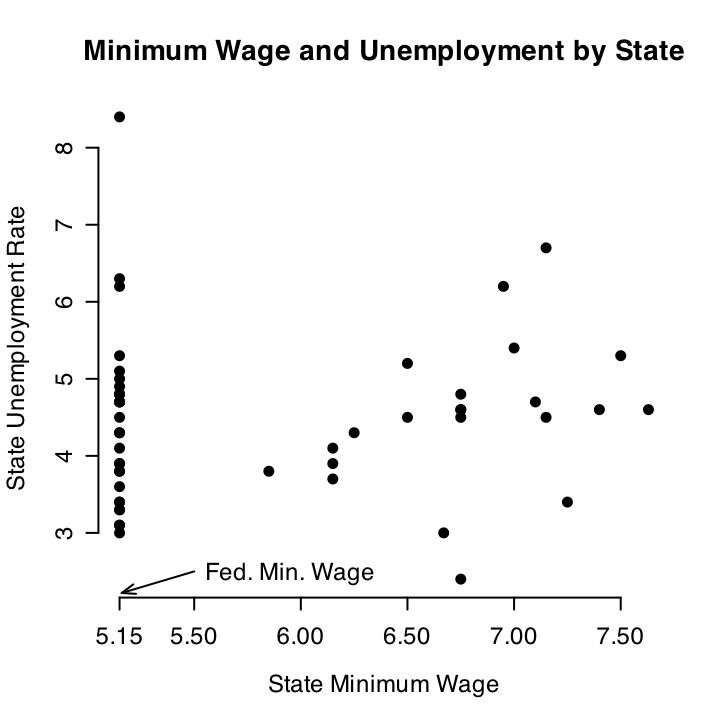 Unsurprisingly, there was no correlation whatsoever. Many factors affect unemployment rate, and raising the minimum wage may have adverse affects beyond simply raising unemployment. At the very least, these data suggest that if we raise the minimum wage the world will not collapse beneath our feet, but I wouldn't anything else into it.
Friday, November 17, 2006
Review of Freakonomics
Though I have read numerous book reviews, having never written a book one, I do not have a good sense of how to compose them. I will remedy that deficiency with a review of Freakonomics by University of Chicago economist Steven D. Levitt and journalist Stephan J. Dubner. The topics discussed in their book are quite different from the intended focus of this blog, but I believe that the authors’ methods can and should inform everyone’s approach to complex issues, such as the environment. I am more ambiguous about the book’s noncommittal attitude, which grew in nearly inverse proportion to the societal importance of their findings, which I will address in more detail further along.
I came to Freakonomics on a whim. Levitt’s name has arisen more than a few times in magazines or over beer with economists, mostly in regard to his unorthodox research. I was intrigued and decided to read it for fun, hoping to learn, but not engage it critically. I succeeded on the former, but as the act of writing this review suggests, Freakonomics does not invite casual readership.
"The conventional view serves to protect us from the painful job of thinking." -- John Kenneth Galbraith
Freakonomics is more or less a compendium of Levitt’s research findings, made accessible by Dubner’s journalistic prose. Unlike most scholars, Levitt’s research does not revolve around a central theme. Rather, Levitt uses the toolkit of economics to empirically address whatever topic suits him, usually at the expense of conventional wisdom, invoking Galbraith’s sentiments above. Levitt’s findings include, but are not limited to:
It would behoove environmentalists to take a similar approach. Take the example of energy. I have observed that the conventional wisdom among some environmentalists is that 1) renewable energy is good; 2) oil and nuclear energy are bad. Assuming the ultimate goal is to reduce carbon dioxide emissions without a concomitant increase in another equally unpleasant pollutant, do these statements hold? It is not a clear issue that can be settled with theory. Rather, it hinges on relative outputs of energy and pollution, which is an empirical question. It would not be optimal to cover the entire country in windmills in order to replace all current petroleum power plants. Likewise, it would hardly suffice to reduce carbon dioxide emissions if we were up to our ears in nuclear waste. My current opinion is that we will need to implement a combination of renewable and nuclear energy quite soon, but I will let the data (once I find them) be my guide.
Freakonomics “doesn’t traffic in morality. If morality represents an ideal world, then economics represent the actual world.”
As the quote above (taken from the Epilogue) suggests, Freakonomics, with a few exceptions*, remains amoral and apolitical. To put it another way, they espouse that the tools of economics are descriptive rather than normative, much like the natural sciences. For topics such as cheating in Sumo wrestling, I am more than happy to agree. What about the connection between legalized abortion and crime? His scientific detachment likely helped Levitt formulate the question without the burden of conflicting ideological objections. Rather than use the findings to inform the abortion debate, Levitt and Dubner retreat with theoretical qualifications. If you believe that embryos are equal in value to some, even small, fraction of a human life, then legalized abortion “kills” more individuals than it saves. If you value individual choice as paramount, then the extraneous affects of abortion are inconsequential. We are back to square one. Given some limitations inherent in their approach, I accept their amoral conclusion. But, for the sake of argument, if future economists could establish a value on an embryo or individual choice, a hedonic approach that is not uncommon, would they still be safely trafficking in description? The issue is important because when it comes to the environment, I am not content with description. For example, economics describes why marine fisheries are depleted unsustainably: lack of clearly defined property rights. That description must be followed up by a prescription: governments must clearly define property rights.
Thus, Levitt and Dubner seek an ultimately untenable position: using data to help untangle a dense thicket of conflicting wisdom, while resting their conclusions on a rarefied higher ground. Nonetheless, I greatly enjoyed the book and believe that we can all learn much from their approach. I should add one more thing. I did not actually “read” the book in a traditional sense, but rather listened to the audiobook while I entered my own mountain of data** in an Excel spreadsheet. It was a rather happy coincidence. Hopefully I can use mine as effectively as Levitt did his.
* For example, Levitt was instrumental in helping the Chicago public school system catch and fire a dozen teachers who were eregious cheaters.
** If you care, I am entering growth data on ecotypes of Arabidopsis thaliana.
I came to Freakonomics on a whim. Levitt’s name has arisen more than a few times in magazines or over beer with economists, mostly in regard to his unorthodox research. I was intrigued and decided to read it for fun, hoping to learn, but not engage it critically. I succeeded on the former, but as the act of writing this review suggests, Freakonomics does not invite casual readership.
"The conventional view serves to protect us from the painful job of thinking." -- John Kenneth Galbraith
Freakonomics is more or less a compendium of Levitt’s research findings, made accessible by Dubner’s journalistic prose. Unlike most scholars, Levitt’s research does not revolve around a central theme. Rather, Levitt uses the toolkit of economics to empirically address whatever topic suits him, usually at the expense of conventional wisdom, invoking Galbraith’s sentiments above. Levitt’s findings include, but are not limited to:
- Real estate agents sell your house for less than it is worth
- Sumo wrestlers often throw matches
- White-collar workers steal bagels
- A candidate’s campaign money does not much increase his chances of winning an election
- Chicago public school teachers cheat on their student’s standardized tests
- Dealing crack is the worst job in America
- Legalized abortion reduces crime
- Swimming pools are more dangerous to children than are guns
- Other than their genes and money, parents have little impact on their child’s performance in school
- Stereotypically black names per se do not hurt an African-American’s chances at getting a job
It would behoove environmentalists to take a similar approach. Take the example of energy. I have observed that the conventional wisdom among some environmentalists is that 1) renewable energy is good; 2) oil and nuclear energy are bad. Assuming the ultimate goal is to reduce carbon dioxide emissions without a concomitant increase in another equally unpleasant pollutant, do these statements hold? It is not a clear issue that can be settled with theory. Rather, it hinges on relative outputs of energy and pollution, which is an empirical question. It would not be optimal to cover the entire country in windmills in order to replace all current petroleum power plants. Likewise, it would hardly suffice to reduce carbon dioxide emissions if we were up to our ears in nuclear waste. My current opinion is that we will need to implement a combination of renewable and nuclear energy quite soon, but I will let the data (once I find them) be my guide.
Freakonomics “doesn’t traffic in morality. If morality represents an ideal world, then economics represent the actual world.”
As the quote above (taken from the Epilogue) suggests, Freakonomics, with a few exceptions*, remains amoral and apolitical. To put it another way, they espouse that the tools of economics are descriptive rather than normative, much like the natural sciences. For topics such as cheating in Sumo wrestling, I am more than happy to agree. What about the connection between legalized abortion and crime? His scientific detachment likely helped Levitt formulate the question without the burden of conflicting ideological objections. Rather than use the findings to inform the abortion debate, Levitt and Dubner retreat with theoretical qualifications. If you believe that embryos are equal in value to some, even small, fraction of a human life, then legalized abortion “kills” more individuals than it saves. If you value individual choice as paramount, then the extraneous affects of abortion are inconsequential. We are back to square one. Given some limitations inherent in their approach, I accept their amoral conclusion. But, for the sake of argument, if future economists could establish a value on an embryo or individual choice, a hedonic approach that is not uncommon, would they still be safely trafficking in description? The issue is important because when it comes to the environment, I am not content with description. For example, economics describes why marine fisheries are depleted unsustainably: lack of clearly defined property rights. That description must be followed up by a prescription: governments must clearly define property rights.
Thus, Levitt and Dubner seek an ultimately untenable position: using data to help untangle a dense thicket of conflicting wisdom, while resting their conclusions on a rarefied higher ground. Nonetheless, I greatly enjoyed the book and believe that we can all learn much from their approach. I should add one more thing. I did not actually “read” the book in a traditional sense, but rather listened to the audiobook while I entered my own mountain of data** in an Excel spreadsheet. It was a rather happy coincidence. Hopefully I can use mine as effectively as Levitt did his.
* For example, Levitt was instrumental in helping the Chicago public school system catch and fire a dozen teachers who were eregious cheaters.
** If you care, I am entering growth data on ecotypes of Arabidopsis thaliana.
Subscribe to:
Posts (Atom)